Autism Testing for Children: When to Consider an Evaluation and What to Expect
Do you have questions about your child’s growth or behavior? You are not alone.
Many parents are not sure where to start. Autism testing can help you find answers. It can help you understand how your child talks, learns, plays, and connects with others.
It can also show your child’s strengths and needs.
This guide explains autism testing in simple terms. You will learn when to consider testing, what happens, and what comes next.
What Is Autism?
Autism affects how a person sees and responds to the world.
It may affect how a child:
Talks and shares ideas
Plays with other children
Handles change
Learns new skills
Reacts to sounds, lights, food, or touch
Every autistic child is different.
Some children talk a lot but find social situations hard. Some speak very little. Others may not speak at all.
Some children enjoy being with people. Others like to spend more time alone.
A child may also have a strong interest in one topic. They may want to follow the same routine each day.
Autism is not a disease. Bad parenting does not cause it.
Autistic children also have many strengths. They may have a strong memory or deep focus. They may notice details that other people miss.
Autism testing can help you understand your child as a whole person.
When Should You Consider Autism Testing?
You know your child best.
It is okay to ask questions if something feels different. You do not need to wait for a serious problem.
You may want to ask about autism testing if your child:
Does not respond to their name
Has trouble talking with others
Repeats words or sounds
Repeats the same body movements
Makes little or unusual eye contact
Finds it hard to make friends
Prefers to play alone
Has very strong interests
Becomes upset by small changes
Follows the same routines each day
Reacts strongly to sounds, lights, or touch
Avoids certain foods because of their texture
Has trouble sharing feelings or needs
A teacher may notice signs at school. They may have concerns about your child’s speech, play, or behavior.
These signs do not always mean your child is autistic. Other needs can look similar.
Autism testing can help you learn more.
Autism Screening and Autism Testing
An autism screening is not the same as a full evaluation.
A screening is a short check. Your child’s doctor may ask you a few questions. You may also fill out a short form.
The screening looks for signs that may need more study. It cannot tell you if your child is autistic.
A full autism evaluation is more detailed. It looks at many parts of your child’s life. This may include speech, play, learning, behavior, and social skills.
A trained expert completes the evaluation. This may be a psychologist or a team of experts.
A screening is a first step. A full evaluation can provide clearer answers.
What Happens During Autism Testing?
Each child is different. The steps may not be the same for every family.
Most autism evaluations include the following parts.
You Talk About Your Concerns
The expert will ask why you want testing.
You can share what you see at home. You can also talk about any concerns from school.
Your thoughts are important. You know your child’s habits and needs.
You Share Your Child’s History
The expert may ask when your child first walked or talked.
They may also ask about:
Sleep
Eating
Play
School
Friends
Daily routines
Past health needs
This helps the expert understand how your child has grown.
The Expert Reviews Records
The expert may read school reports or medical records.
Teacher notes may also be helpful. These records show how your child acts in different places.
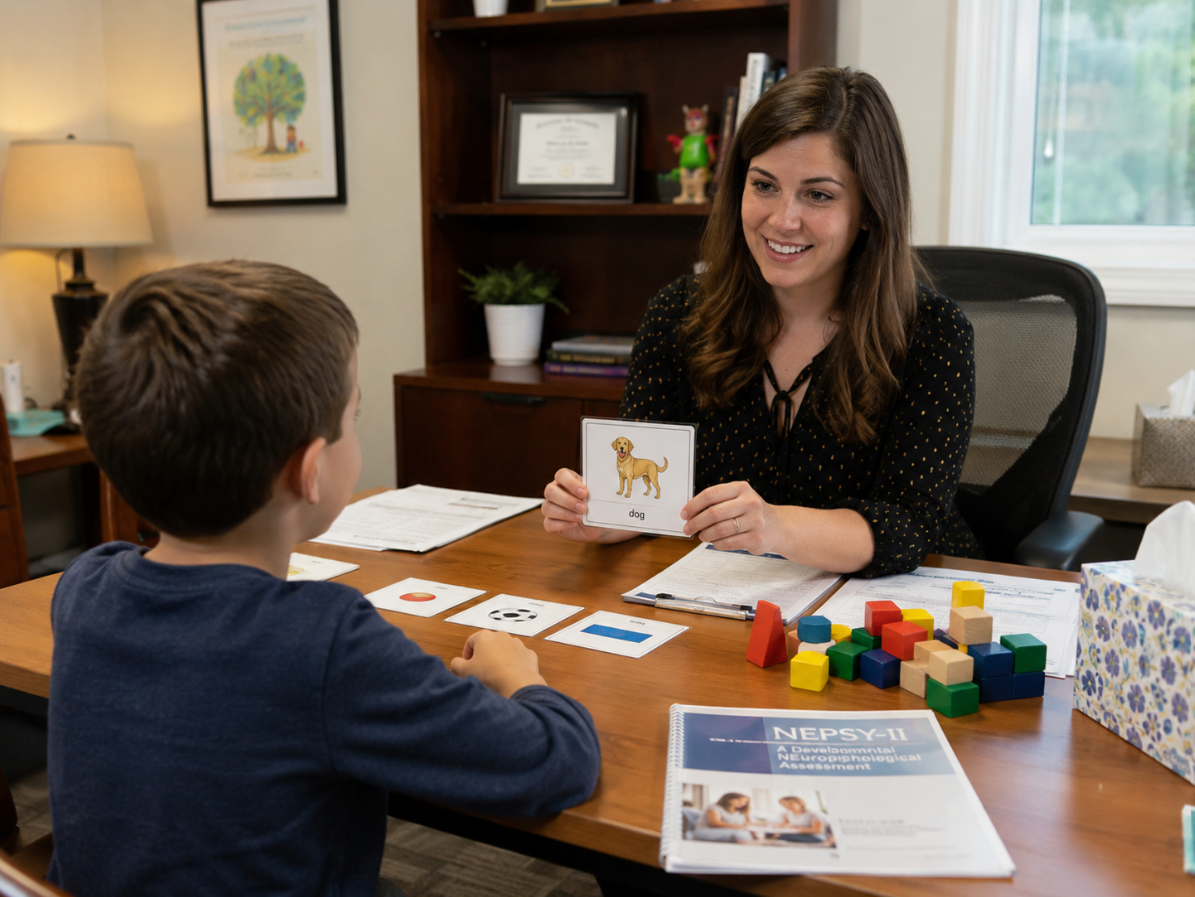
Your Child Completes Activities
Your child will spend time with the expert.
They may play, look at pictures, or answer questions. They may also complete simple tasks.
The activities will match your child’s age and needs.
The expert will watch how your child talks, plays, and responds.
You Complete Forms
You may answer questions about your child’s daily life.
A teacher may also complete a form. This can show how your child acts at school.
The forms may ask about feelings, behavior, play, and social skills.
You Receive the Results
The expert will study all the information.
You will then meet to discuss the results. The expert will explain what they found and what it means.
You should have time to ask questions. You should also receive clear next steps.

What Does Autism Testing Look At?
Autism testing may look at several areas.
The exact tests will depend on your child’s age and needs.
Speech and Language
The expert looks at how your child uses words and gestures. They also check how well your child understands others.
Social Skills
The expert looks at how your child connects with people.
This may include sharing, playing, and taking turns. It may also include starting or joining a talk.
Behavior
The expert may look for repeated actions or strong routines.
They may also ask how your child handles change.
Learning
Some tests look at how your child thinks and learns.
These tests can show what is easy or hard for your child.
Daily Skills
The expert may ask about tasks your child does each day.
These tasks may include:
Eating
Getting dressed
Following directions
Completing schoolwork
Caring for personal needs
Focus and Memory
The evaluation may also look at focus and memory.
This can help find other needs that may affect your child.
Your child may not need every type of test. The expert will choose the right tests for your child.
What Can the Results Tell You?
The results may show if your child meets the signs of autism.
They can also show your child’s strengths and needs.
The results may help you understand:
How your child learns
How your child shares ideas
How your child connects with others
What may cause stress
What helps your child feel calm
What support may help at home
What support may help at school
You will often receive a written report.
The report will explain the results. It should also list steps that may help your child.
You can share the report with your child’s doctor or school. You can also share it with other people who support your child.
What Happens After the Evaluation?
The next steps will depend on the results.
If your child is autistic, the expert may suggest support. This could include:
Speech therapy
Help with daily skills
Support for feelings or behavior
Help with social skills
Changes at school
Support for your family
The report may also help you ask for school support.
Your child may be able to get an IEP or 504 Plan. The school will review your child’s needs before making that choice.
Your child may not meet the signs of autism. The evaluation can still be helpful.
The results may point to another need. This could be ADHD, worry, a speech delay, or a learning problem.
Either way, you will know more about your child. You will also have a clearer idea of what to do next.
What Parents Should Know
A Screening Is Not a Diagnosis
A screening is only a short check. A full evaluation is needed to find out if a child is autistic.
Autism Is Different for Every Child
There is no single sign of autism.
Each child has their own strengths and needs.
Some Signs Are Hard to Notice
Some children hide their struggles around other people.
Girls and children from some groups may be tested later. Their signs may look different or be missed.
Testing Can Help You Find Support
Clear results may help your child get support at home and school.
You Can Ask Questions
It is okay to ask the expert to explain a word or result.
A good expert will listen and answer your questions.
You Do Not Have to Wait
You can ask about autism testing when you first have concerns.
Early answers may help your child get support sooner.
Talk to The Mind Center About Autism Testing
The Mind Center offers autism testing for children and students.
We help families in Washington, DC, Maryland, Virginia, and South Florida.
Our team makes each step as clear and calm as possible. You do not need to know what type of testing your child needs. We can listen to your concerns and help you choose the next step.
Contact The Mind Center today to ask about autism testing for your child.
The Bottom Line on Autism Testing
Autism testing can help you understand your child.
It can show how your child talks, learns, plays, and connects with others. It can also help you find the right support.
You do not need to wait until your concerns become urgent.
Asking about an evaluation is a caring first step. Contact The Mind Center to learn about autism testing near you.
About The Mind Center
At The Mind Center LLC, we specialize in comprehensive psycho-educational evaluations for children, teens, and college students. Our experienced clinicians help families identify learning differences such as ADHD, learning disabilities such as dyslexia, dysgraphia, dyscalculia, as well as autism spectrum disorders and giftedness, while also providing documentation for IEP plans, 504 accommodations, and standardized testing accommodations such as the SAT, LSAT, MCAT and ACT.
With 15+ years of experience and over 1,000 evaluations completed, our team works closely with families and schools to uncover each child’s unique learning profile and provide clear recommendations that help students succeed academically and emotionally.
Areas We Serve
The Mind Center works with families seeking psychoeducational evaluations and ADHD testing across the Washington DC metropolitan area and South Florida. Many parents reach out when their child is struggling in school and they want clear answers about learning differences, attention challenges, or academic accommodations.
Washington DC, Maryland, and Virginia
Washington, DC
Montgomery County, Maryland
Bethesda • Rockville • Potomac • Silver Spring
Prince George’s County, Maryland
Bowie • Upper Marlboro • Greenbelt • Laurel
Arlington County, Virginia
Arlington
Fairfax County, Virginia
McLean • Fairfax • Alexandria
South Florida
Broward County
Fort Lauderdale • Hollywood • Pembroke Pines
Palm Beach County
Boca Raton • West Palm Beach • Palm Beach Gardens
Miami-Dade County
Miami • Coral Gables • Aventura
Services We Provide
Our evaluation services include:
ADHD Testing
Dyslexia Evaluations
Gifted & Talent Assessments
Comprehensive Psychoeducational Evaluations
College Accommodation Evaluations
Independent Educational Evaluations (IEE)
Private School Admission Testing
Learning Disability Assessments
Neuropsychological Evaluations