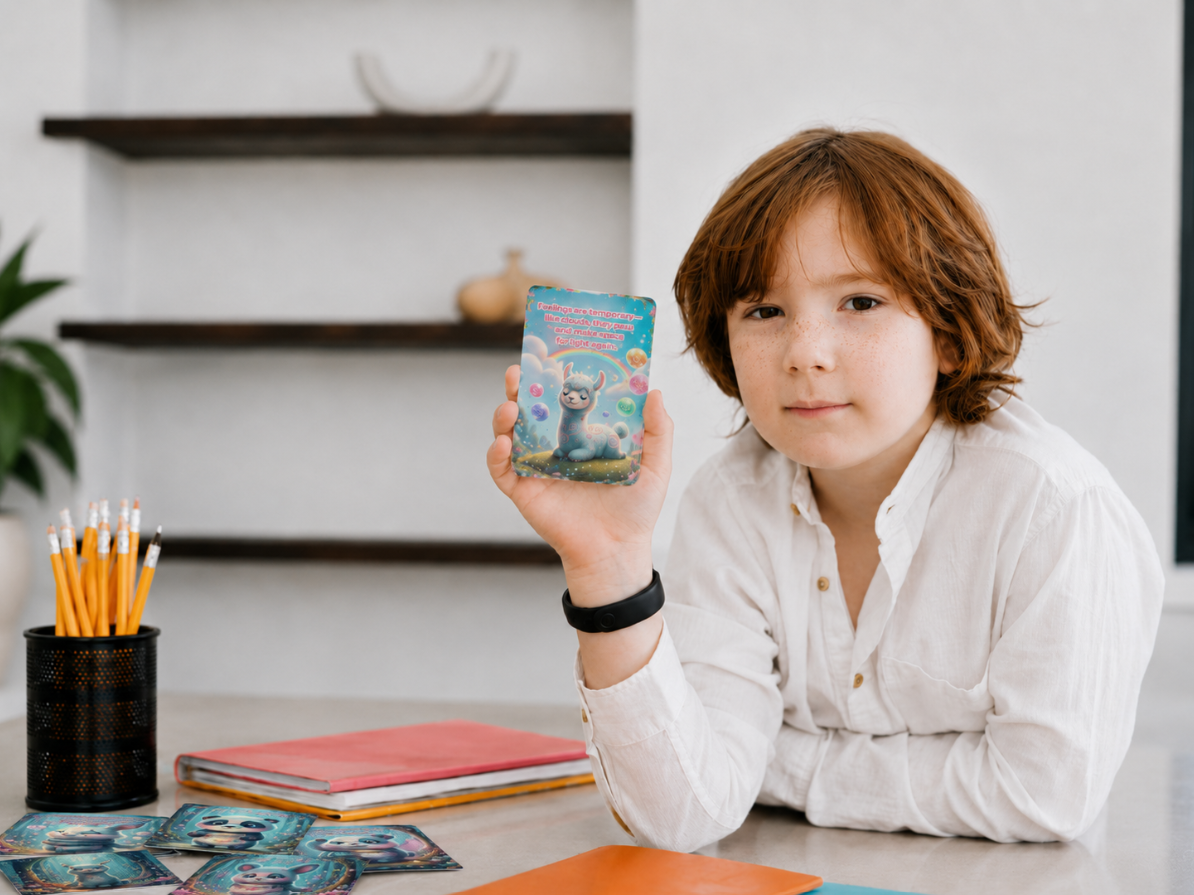
Affirmation cards contain short, encouraging messages that children can read, say, or discuss. They may help children practice kinder and more helpful ways of talking to themselves. Used thoughtfully, they can be a simple, low-cost tool that supports emotional skills at home and in the classroom.
That said, they are not magic. A card with a few kind words will not erase anxiety, fix attention struggles, or replace professional support. This article explains what affirmation cards are, how to choose ones that actually help, and how to use them without putting pressure on your child.
What Affirmation Cards Are Really Meant to Do
Affirmation cards are not about pretending everything is fine. They are not meant to push children into forced positivity or make them repeat phrases until difficult feelings disappear. That approach can actually backfire. When a child is told to say "I am always happy" while feeling sad or scared, the message can feel false and even a little insulting.
The goal is different. A helpful affirmation card gives a child a realistic, kind phrase they can actually believe. It connects to their own experience, and it points toward something they can do. Phrases like "I can ask for help" or "Mistakes can help me learn" work well because they acknowledge that hard moments happen. They also remind the child that they have options.
Children who struggle with negative self-talk often say things to themselves that they would never say to a friend. Affirmation cards offer a gentle way to practice a different internal voice. Over time, this kind of practice can support self-reflection and simple coping. Results vary from child to child, and progress is usually gradual rather than immediate.
Choosing Phrases That a Child Can Actually Believe
Not all positive statements are equally useful. Some children, especially older ones or those with anxiety, will quickly reject a phrase that feels exaggerated or untrue. If a child reads "I am the best at everything" and knows that is not accurate, the card loses its credibility.
The most helpful affirmations for kids tend to be:
Believable and grounded in real life. Phrases such as "I can take one step at a time" or "I do not have to get everything right the first time" feel honest. They do not demand perfection. They simply offer a more reasonable way to see a situation.
Connected to action. Phrases like "I can try a different way" or "I can be kind to myself" suggest that the child has some agency. This is encouraging without being overwhelming.
Gentle and non-judgmental. "My feelings matter" is a simple but powerful message. It tells the child that their inner life is valid, even when emotions are uncomfortable.
Avoid phrases such as "I am perfect," "Nothing can hurt me," or "I am always happy." These statements may feel hollow or even dishonest to a thoughtful child, and they do not build genuine confidence.
When possible, involve the child in choosing or creating the phrases. A child who writes their own card is far more likely to connect with what it says.
How to Use Affirmation Cards at Home
Using affirmation cards at home does not require a strict routine or a big time commitment. Small, consistent moments work better than lengthy sessions.
One simple approach is to let your child choose one card at the start of the day. Read the message together, then ask what it means to them. You might follow up by connecting the phrase to something real in their life. If the card says "I can ask for help," you could ask: "Can you think of a time this week when asking for help would have made things easier?" Then invite them to name one small action they could take.
Placement matters too. Putting a card near a homework area, on a bathroom mirror, or tucked into a backpack can serve as a quiet reminder throughout the day. Some families use a card before a difficult task, such as a test, a doctor's appointment, or a hard conversation. Others pull a card out after a mistake, as a way to reset rather than spiral into self-criticism.
A few important ground rules: Do not force your child to read a card aloud. Do not use the cards as a form of punishment or correction. And swap out cards when the messages stop feeling useful. A phrase that resonates in September may not carry the same weight in March.
Inviting children to create their own cards is especially effective for kids who have strong opinions or who resist being told what to think. Give them a blank index card and ask them to write something kind they would say to a friend going through a tough day.
How Teachers Can Use Affirmation Cards in the Classroom
Educators can weave positive affirmation cards into classroom routines without disrupting academic time. A brief moment during morning meeting, a check-in at the start of a writing block, or a calm-down option during transitions can all benefit from a simple card prompt.
Teachers might place a small card collection in a calm corner or reading area, where students can browse during free moments. Cards can also support individual meetings with students who need a quiet confidence boost before a test or a challenging project.
One important boundary: teachers should not require children to share private feelings in front of the class. Affirmation cards are meant to support personal reflection, not public performance. If a card opens a meaningful conversation, that is wonderful. If a child prefers to stay quiet, that choice should be respected.
Affirmation cards can support classroom relationships and help build emotional vocabulary. They work best alongside consistent routines, strong teacher-student relationships, and access to school counselors when needed. They are not a substitute for individualized services, IEP supports, or mental health resources.
To learn more about The Mind Center's approach to supporting children at school, including evaluations and school-based services, visit the services overview page.
What the Research Actually Says
Self-affirmation research has explored how affirming one's core values can reduce stress and support flexible thinking. Some of this work is encouraging. However, it is important to be honest: the broader research on self-affirmation is not the same as research on commercial affirmation cards specifically. These are different things, and the two should not be treated as identical.
What this means in practice is that affirmation cards may support positive self-talk, reflection, and coping for some children. For others, especially those dealing with more significant emotional or learning challenges, the benefit may be minimal on its own. Results depend on the child's age, temperament, how the cards are used, and what other support is in place.
Affirmation cards do not cure anxiety, depression, ADHD, trauma, or low self-esteem. They do not guarantee better grades, improved behavior, or lasting confidence. If your child's negative self-talk, school avoidance, anxiety, or emotional difficulties are affecting daily life at home or school, a conversation with a qualified professional is the appropriate next step.

When to Seek Additional Support
Affirmation cards can be a helpful part of a child's daily routine, but some children need more than kind words on a card. If your child regularly expresses hopelessness, refuses school, struggles to manage strong emotions, or shows signs of significant worry or low mood, these are signals worth taking seriously.
The Mind Center for Kids provides psychological services, therapy, psychoeducational evaluations, and school support for children, teenagers, adults, and families. With approximately 15 years of experience and more than 5,000 school-based evaluations completed, The Mind Center offers practical, clear guidance that parents and educators can actually use. Services are available in Washington, DC, Maryland, Virginia, and South Florida, including Palm Beach, Broward, and Miami-Dade counties.
Families can explore Mighty Minds for additional resources, or reach out directly to the team through the contact page to ask about a consultation. You can also call or text (561) 888-0102.
Frequently Asked Questions
Q: What are affirmation cards for?
Affirmation cards are tools that offer short, encouraging messages to help children practice kinder, more realistic ways of talking to themselves.
They are often used at home, in classrooms, or during therapy to support positive self-talk and emotional reflection. A card might offer a phrase like "I can ask for help" or "Mistakes can help me learn," giving a child a small mental anchor during a tough moment. They work best as a supportive tool used alongside consistent adult guidance, not as a standalone fix for serious emotional concerns.
Q: What is the strongest affirmation?
The strongest affirmation is one that feels believable, kind, and connected to something the child can actually do.
There is no single phrase that works for every child. A statement like "I can take one step at a time" tends to be effective because it is honest, realistic, and action-oriented. Overly broad statements such as "I am perfect" or "I am always happy" often feel false and can undermine the child's trust in the process. The most powerful affirmation is the one a child genuinely connects with, which is why involving them in choosing or writing their own phrases matters.
Q: What are some effective affirmation cards?
Effective affirmation cards use simple, grounded language that a child can relate to without feeling pressured to pretend everything is fine.
Some examples that tend to resonate with children include: "I can be kind to myself," "My feelings matter," "I do not have to get everything right the first time," "I can try a different way," and "I can ask for help." Cards that are age-appropriate, visually appealing, and written in the child's own reading level are more likely to be used consistently. Allowing children to choose from a small collection, rather than assigning a specific card, also increases engagement.
Q: What are 5 good affirmations?
Five affirmations that are realistic, encouraging, and appropriate for children are: "I can ask for help," "Mistakes can help me learn," "I can take one step at a time," "My feelings matter," and "I can be kind to myself."
Each of these works because it acknowledges that life includes challenges without blaming the child for having them. They also point toward an attitude or action the child can practice, rather than demanding a feeling the child may not have. For children who are skeptical of positive phrases, starting with just one card and discussing what it means in real life can make the experience feel more genuine and less forced.
Q: What is the best short positive affirmation?
"I can ask for help" is one of the most practical and accessible short affirmations for children of almost any age.
It is brief, believable, and carries a meaningful message: that reaching out is a strength, not a weakness. For children who struggle with perfectionism, anxiety, or a fear of looking incapable, this phrase directly challenges a common and harmful thought pattern. Other strong short options include "I am enough" for children working on self-acceptance, or "One step at a time" for children who feel overwhelmed. The best choice depends on what the individual child is working through.
The Bottom Line on Affirmation Cards
Affirmation cards are a simple, accessible way to help children practice more realistic and compassionate self-talk. When chosen carefully, used without pressure, and connected to real moments in a child's life, they can support emotional reflection at home and in the classroom. They are not a cure for anxiety, low confidence, or learning difficulties, and they should never replace professional support when a child is genuinely struggling.
If worry, low self-esteem, attention difficulties, or strong emotions continue to affect your child's daily life at home or school, affirmation cards alone are unlikely to be enough. The Mind Center for Kids supports children, teenagers, and families through therapy, psychoeducational evaluations, and school-based services across Washington, DC, Maryland, Virginia, and South Florida. Reach out through the website, call or text (561) 888-0102, or submit a message through the contact page to talk through the right next step for your child.