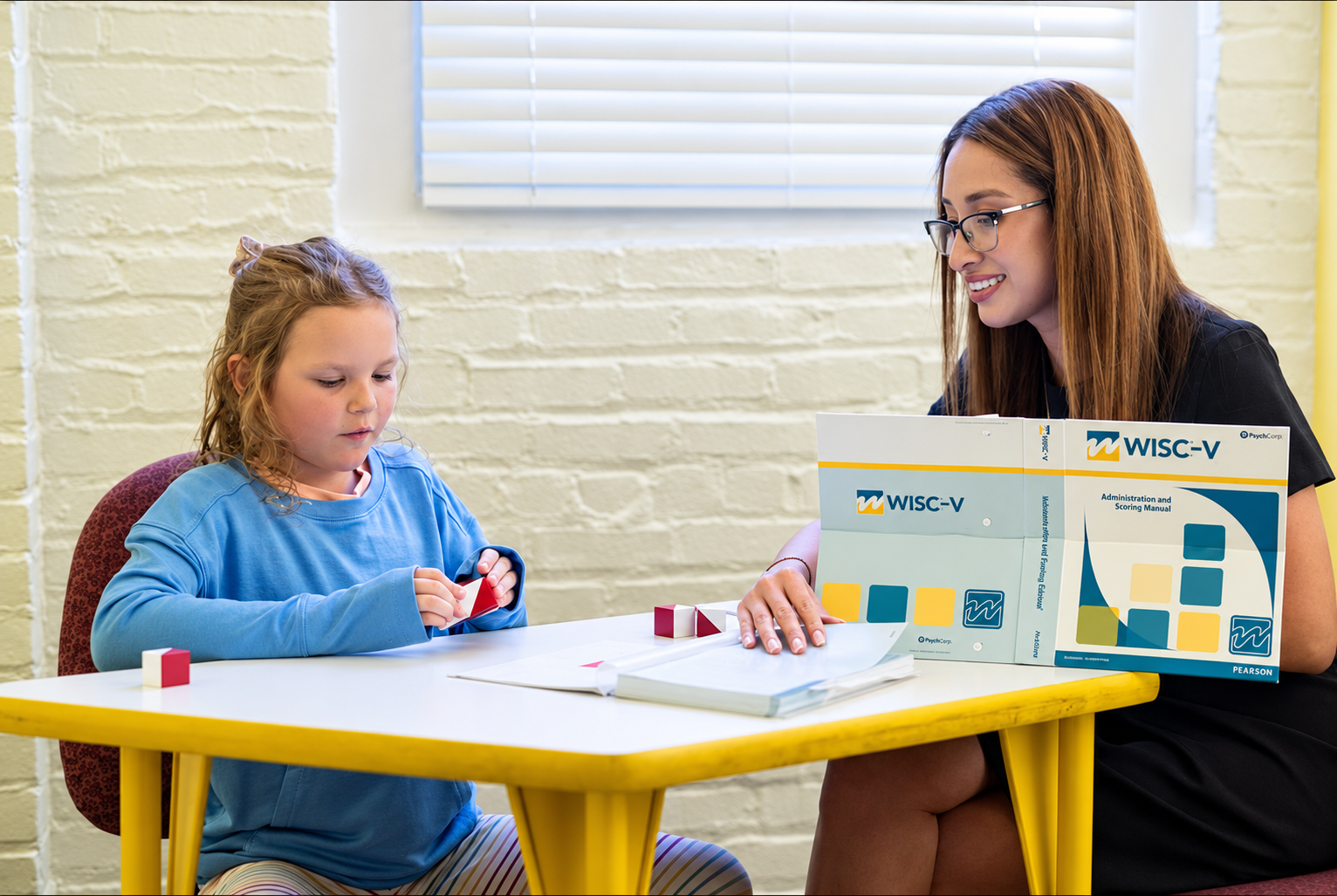
Yes, IQ scores can change in children, and a shift between two evaluations does not automatically mean your child has become more or less capable. Scores reflect how your child performed on a specific set of tasks on a specific day, compared to other children the same age.
A score is an estimate, not a permanent label. Younger children tend to show more variation between evaluations, while scores generally become more stable as children move into adolescence. That said, individual differences remain at every age, and no single number captures the full picture of a child's thinking and learning.
Why IQ Scores Are Not Fixed Numbers
IQ tests measure a sample of cognitive skills at a single point in time. They compare your child's performance to a standardized group of children the same age. When your child learns new skills, those skills do not automatically push the score higher, because other children their age are also developing. The comparison group moves too.
What actually causes a score to look different from one evaluation to the next? Several things can shift results in either direction.
Testing conditions matter more than most parents expect. A child who is anxious, sick, sleep-deprived, or unfamiliar with the examiner may not perform at their best. In practice, this is one of the most common reasons a score drops unexpectedly. Fatigue during a long session, especially for a child with attention difficulties, can also compress a score below what the child is genuinely capable of.
The test itself matters too. Different IQ tests measure overlapping but not identical skill sets. The WISC-V and the Stanford-Binet 5, for example, weight verbal and visual tasks differently. Switching from one test to another between evaluations can produce results that are not directly interchangeable. Even updated versions of the same test, like moving from the WISC-IV to the WISC-V, involve different norms and sometimes different tasks, which can affect the outcome.
Language background and cultural context also play a role. A child who speaks English as a second language or who comes from a cultural background that approaches problem-solving differently may face tasks that do not reflect their actual abilities. Test selection and interpretation should always account for a child's individual context.
Finally, familiarity with recently completed tests can inflate retesting results if the gap between evaluations is too short. This is one reason that retesting timelines depend on the specific test and the purpose of the evaluation.
What a Score Change Actually Tells You
A change in IQ scores does not explain its own cause. A 5-point difference may fall entirely within normal measurement variation, while a 20-point difference may still reflect testing conditions rather than a true shift in cognitive ability. Every IQ score comes with a confidence interval, which is a range showing the uncertainty built into that estimate. A score of 95 might carry a confidence interval of 88 to 102, meaning the "true" score likely falls somewhere in that range.
The pattern I keep seeing with parents is a focus on two overall numbers side by side, with less attention paid to the subtests underneath. Two children can earn the same overall IQ score through very different profiles of strengths and needs. Comparing only the composite scores misses most of the useful information.
What usually trips people up here is assuming a higher score means the first evaluation was wrong, or a lower score means something has gone wrong with the child. Both interpretations are often premature without a fuller review of the results.
A score change is a prompt for a conversation, not a conclusion. A qualified psychologist can look at the full pattern of results, the child's history, everyday functioning, and what was happening during each evaluation, and give you a much more grounded interpretation than the numbers alone provide.
When Can IQ Scores Change in Children and Retesting Makes Sense
Retesting is appropriate when there is a clear question to answer. Routine repeated testing to chase a higher score is not recommended and can actually produce inflated results due to practice effects.
Retesting may be worth discussing when the earlier evaluation was incomplete or cut short, when testing conditions significantly interfered with performance, when a child's concerns or presenting needs have changed substantially, or when updated documentation is needed for school accommodations, an IEP, a 504 Plan, or college testing accommodations. For families exploring gifted identification or specialized school placement, updated evaluations can also provide more current data.
If your child is losing previously mastered skills or showing a noticeable change in daily functioning, that is a different situation. Bring those concerns to your child's pediatrician or healthcare provider first, as those changes may point to something medical rather than a testing question.
Timing for retesting is not one-size-fits-all. The appropriate gap depends on the specific test used, the child's age, and the reason for re-evaluation. A clinician familiar with your child's history can help you determine whether and when another evaluation would actually be informative.
The Mind Center for Kids offers comprehensive cognitive and psychoeducational evaluations for children and teenagers across Washington, DC, Maryland, Virginia (including Northern Virginia), and South Florida, covering Palm Beach, Broward, and Miami-Dade counties. Families can review the range of available services to understand what a full evaluation covers and how it connects to school planning, therapy, and support.

Factors That Influence Score Stability Over Time
Score stability in children is not a simple yes or no. Research on cognitive development consistently shows that scores measured before age 5 are the least predictive of later scores, and stability increases through middle childhood and into the teen years. But stability at the group level does not guarantee consistency for any individual child.
Genuine changes in skill and learning experience can contribute to score changes over time. A child who receives targeted intervention for a reading difficulty, or who gains significantly more exposure to academic language, may perform better on certain verbal subtests later. The trade-off is that these improvements may be real and meaningful for the child's daily life without translating into a large composite score change, because the normative comparison group is also progressing.
Enriched learning environments, access to quality instruction, and consistent support for executive functioning can all influence how a child develops cognitively. None of these guarantee a specific score increase, and anyone who promises otherwise is overstating what the evidence supports.
The catch is that disadvantaged access to learning, chronic stress, and unaddressed learning differences can suppress scores in ways that do not reflect a child's potential. This is exactly why evaluation findings need context and why a report from a qualified examiner includes more than a number.
For families who need evaluations conducted remotely, The Mind Center also offers virtual psychoeducational testing washington dc for appropriate cases, giving families more flexibility without compromising the quality of the assessment.
How to Read Your Child's Results With More Confidence
When you receive an evaluation report, look beyond the overall IQ number. Ask the evaluator about the confidence intervals around each score. Ask which subtests were stronger and which were lower, and what that pattern suggests for how your child learns best. Ask how the results connect to your child's everyday behavior at home and at school.
A well-written report translates test results into practical steps. It should tell you not just what the scores were, but what they mean for instruction, support, and next steps. If the report you received does not do that, or if you have questions about an older evaluation that a new school or provider is asking about, a consultation can help clarify what the results actually indicate.
You can find a full services overview on The Mind Center's website, or reach out directly through the contact page to ask whether a new or updated evaluation would be useful for your child's current situation. The team at The Mind Center for Kids can be reached by phone or text at (561) 888-0102.
Frequently Asked Questions
Q: What should a 7 year old's IQ score be?
The average IQ score for a 7-year-old, like any age group, falls around 100, because IQ tests are designed so that 100 represents the middle of the range for each age.
Scores between roughly 85 and 115 are considered within the average range, and most children fall somewhere in that band. At age 7, scores can be less stable than they will be later in childhood, so a single result should be treated as one data point rather than a final verdict on your child's abilities.
Q: How to deal with high IQ people?
Interacting well with a high-IQ child or adult usually comes down to respecting their pace, their depth of curiosity, and their tendency to ask questions that go well beyond the surface.
For parents and teachers, this often means offering more complex material before a child loses interest, taking their questions seriously even when the answers are hard, and avoiding the assumption that high cognitive ability means emotional maturity is equally advanced. The trade-off many families face is that a child who processes ideas quickly may still struggle with frustration tolerance, social dynamics, or anxiety, and those needs deserve just as much attention as academic ones.
Q: Do children inherit IQ from mom or dad?
Cognitive ability has a meaningful genetic component, but it is influenced by both parents and shaped significantly by environment, so there is no clean answer pointing to one parent.
Research in behavioral genetics consistently shows that IQ has a heritable component, meaning genes contribute to differences between people. But heritability does not mean destiny. Access to quality learning, nutrition, early language exposure, and responsive caregiving all influence how cognitive potential develops. Attributing a child's abilities solely to one parent oversimplifies what is genuinely a complex interaction between genes and experience.
Q: What are signs of high IQ in children?
Common signs include an unusually large vocabulary for their age, strong memory for details, intense curiosity about how things work, the ability to learn new concepts quickly, and a tendency to ask layered or unexpected questions.
Some high-IQ children also show a preference for older company, a strong sense of humor, or the ability to think through abstract ideas earlier than peers. The catch is that these traits look different in every child, and some gifted children are twice-exceptional, meaning they have both high cognitive ability and a learning difference or attention difficulty. A comprehensive cognitive evaluation gives you a much clearer picture than behavioral signs alone.
Q: What is the strongest predictor of a child's IQ?
Early cognitive testing is one of the strongest statistical predictors of later IQ, but parental education, home learning environment, and access to quality early education are among the most consistent environmental predictors across the research.
Genetic factors also contribute significantly over time, with heritability estimates generally increasing through childhood and into adulthood. What this means practically is that no single factor determines where a child lands. A child raised in a language-rich, supportive environment with access to good schooling has meaningful advantages regardless of where early scores fall. Prediction at the group level does not translate to certainty for any individual child.
The Bottom Line on Whether IQ Scores Can Change in Children
IQ scores can change in children, and understanding why they change matters more than reacting to the number itself. A shift between two evaluations could reflect differences in testing conditions, a change in the test used, your child's development, or normal measurement variation. It rarely tells a complete story on its own.
The most useful thing you can do when you see a score change is bring it to a qualified professional who can review both sets of results alongside your child's history, school performance, and everyday functioning. That full picture is what leads to useful recommendations, not a comparison of two composite numbers taken out of context.
Have questions about a change in your child's IQ scores? Schedule a consultation with The Mind Center for Kids to discuss the results and whether further evaluation may be helpful. Families in Washington, DC, Maryland, Virginia, and South Florida can reach the team by phone or text at (561) 888-0102, or visit themindcenterforkids.com to get started.