
A psychoeducational evaluation focuses on how your child learns and performs in school, examining thinking skills, reading, writing, math, attention, and behavior. A neuropsychological evaluation goes deeper into how brain development and medical history connect to thinking, memory, language, and other cognitive abilities.
Most parents hear one of these terms from a teacher, pediatrician, or specialist, and immediately wonder whether they are choosing the right one. The confusion is understandable. The two evaluations overlap significantly, and neither is automatically the better choice for every child.
What a Psychoeducational Evaluation Is Designed to Examine
A psychoeducational evaluation looks at the connection between how your child thinks and how they perform academically. It typically covers cognitive abilities (often called IQ), reading decoding and comprehension, written expression, math reasoning and calculation, attention, working memory, processing speed, and sometimes emotional or behavioral concerns.
This type of evaluation is often the right starting point when your child is struggling with reading, writing, or math, when a teacher has flagged possible learning differences, or when you are seeking documentation for a 504 Plan, an IEP, or school-based accommodations. School psychologists conduct these evaluations as part of public school processes. Privately, appropriately trained and licensed psychologists also conduct them.
In practice, the pattern that comes up repeatedly is that parents assume a psychoeducational evaluation only looks at grades and test scores. It does not. A thorough psychoeducational evaluation can examine reasoning, processing speed, working memory, attention, and even behavioral or emotional factors that affect school performance. The scope depends on your child's specific concerns and the evaluator's training.
The trade-off is scope relative to complexity. If your child has a significant medical history, a known neurological condition, a history of head injury, or concerns that go well beyond the classroom, a psychoeducational evaluation may not fully address every question on the table.
What a Neuropsychological Evaluation Adds to the Picture
A neuropsychological evaluation examines how brain functioning and development relate to thinking and behavior. It is not a brain scan. No imaging equipment is involved. Instead, a neuropsychologist uses standardized tests and observation to assess a broader and often more detailed range of abilities: memory (both immediate and delayed), executive functioning, attention across multiple contexts, language processing, visual-spatial skills, fine motor coordination, and social cognition.
A neuropsychologist is a licensed psychologist who has completed specialized postdoctoral training in the relationship between brain development and behavior. That distinction in training matters most when the questions being asked are more complex, such as when a child has epilepsy, has experienced a traumatic brain injury, has a premature birth history, or presents with a complicated mix of symptoms that has not responded well to earlier interventions.
What usually trips people up here is the assumption that neuropsychological testing is always more thorough or more accurate than psychoeducational testing. That is not consistently true. A well-conducted psychoeducational evaluation from a skilled clinician can identify ADHD, dyslexia, and other learning disabilities just as reliably for many children. The difference is in the specific questions being answered, not in which evaluation is inherently superior.
The catch with neuropsychological evaluation is access and timeline. Neuropsychologists with pediatric specialization can have longer waitlists and higher out-of-pocket costs. For a child whose primary concerns are reading and writing, that wait may delay support unnecessarily.
Side-by-Side: Typical Differences Between the Two Evaluations
The table below outlines common distinctions. Keep in mind that actual testing varies by provider, referral question, and the child's specific profile.
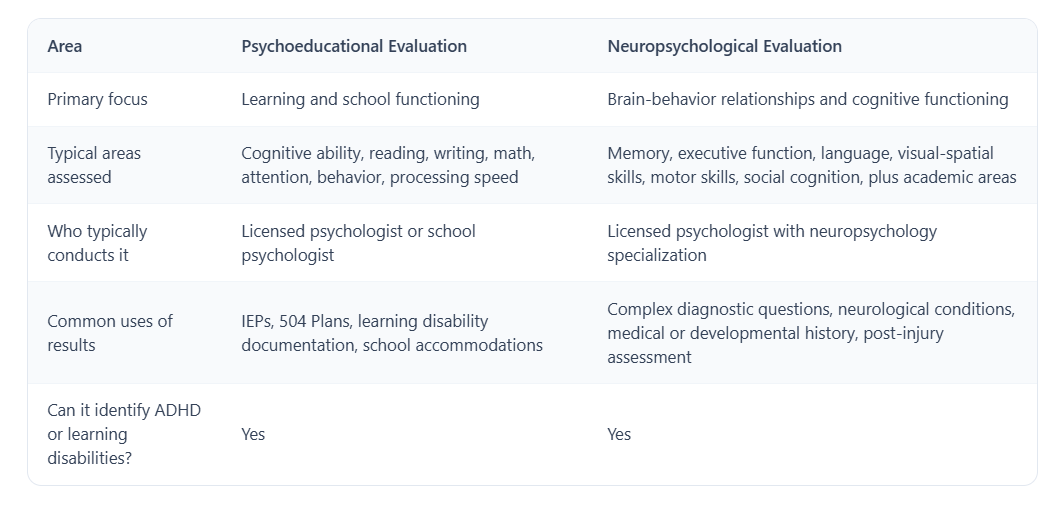
Neither evaluation guarantees a specific diagnosis, an IEP, or particular accommodations. Both provide information. What happens with that information depends on the school, the treatment team, and the recommendations in the report.
When One Evaluation May Fit Better Than the Other
For most children who are struggling with reading, writing, math, attention, or general school progress without a complicated medical or developmental history, a psychoeducational evaluation is typically where you start. It answers the school-based questions most families are asking, and the results can support a referral for therapy, tutoring, or school-based services fairly quickly.
A neuropsychological evaluation tends to fit better when your child has a known neurological condition such as epilepsy or a history of traumatic brain injury, when earlier evaluations and interventions have not explained the full picture, when the concerns span multiple cognitive domains in ways that seem unusually complex, or when a medical specialist has specifically recommended neuropsychological assessment as part of a treatment plan.
Children rarely need both evaluations at the same time. If your child has had recent testing at school or through a private provider, sharing those records with a new evaluator can avoid unnecessary repeat testing and reduce both cost and fatigue for your child.
For families in the Washington, DC area exploring options, autism testing washington dc is one specific service offered through The Mind Center for Kids, which serves families across DC, Maryland, Virginia (including Northern Virginia), and South Florida (Palm Beach, Broward, and Miami-Dade counties).
What the Evaluation Process Looks Like in Practice
Regardless of which type of evaluation your child completes, the process usually follows a similar structure. It begins with a clinical interview with you as the parent, a review of school records and any previous evaluations, and standardized questionnaires completed by you and your child's teacher. The testing itself happens across one or more appointments depending on the scope of the evaluation and your child's age and stamina.
After testing is complete, the evaluator scores and interprets the results, then prepares a written report. A feedback meeting follows, where the clinician walks you through the findings and recommendations in plain language. At The Mind Center for Kids, reports are written to be clear and practical, not buried in clinical jargon that leaves parents more confused than when they started.
The recommendations in the report may address school support, therapy, coaching, medical referrals, or accommodations for standardized testing and college entry. With roughly 15 years of experience and more than 5,000 school-based evaluations completed, the team at The Mind Center for Kids has worked directly with families, schools, and IEP teams across multiple states to translate evaluation findings into real-world support.
Questions Worth Asking Before You Schedule
Choosing between neuropsychological vs psychoeducational testing is easier when you know what questions to bring to the first conversation with a provider. Ask which specific questions the evaluation is designed to answer. Ask about the evaluator's training and experience with your child's particular concerns. Find out whether previous school records or evaluations can be incorporated so your child is not repeating tasks they have already completed. Ask what the report and feedback meeting will include, and confirm fees, the expected timeline, and whether in-person or virtual appointments are available for your situation.
For some families, virtual psychoeducational testing washington dc is a practical option when clinically appropriate and permitted for the specific services needed. Not every evaluation can be completed entirely online, so confirming this with your provider before scheduling is important.
The Mind Center for Kids offers a full range of evaluation services, including psychoeducational evaluations, neuropsychological evaluations, ADHD testing, autism assessments, learning disability evaluations, and more, for children, teenagers, and adults across its service areas. You can reach the practice by calling or texting (561) 888-0102.
Frequently Asked Questions
Q: What is the best age to do a psychoeducational assessment?
There is no single best age, but most evaluations become most informative once a child has had enough time in school to show a consistent pattern of strengths and challenges, typically around age 6 or 7 and older.
That said, concerns about development, attention, or learning can be explored earlier when there is a clear reason to do so. For older teenagers and adults, psychoeducational assessments remain valid and useful, particularly when seeking documentation for college accommodations or workplace support. The right time is usually when the questions being asked are specific enough that testing can provide meaningful answers.
Q: Is ADHD testing psychological or neuropsychological?
ADHD testing can be conducted through either a psychoeducational evaluation or a neuropsychological evaluation, depending on the complexity of the child's concerns and the evaluator's training.
A well-qualified licensed psychologist conducting a psychoeducational evaluation can assess attention, working memory, processing speed, behavior ratings, and executive functioning in ways that reliably identify ADHD. A neuropsychologist may assess these same areas with additional depth when the clinical picture is more complicated. Neither type holds a monopoly on ADHD diagnosis. What matters most is that the evaluator uses validated tools and gathers information from multiple sources, including parents, teachers, and the child.
Q: Why would a child need a neuropsychologist?
A child may be referred to a neuropsychologist when their concerns are complex, involve a known neurological condition, or have not been fully explained by earlier evaluations or interventions.
Common reasons for a neuropsychological referral include a history of traumatic brain injury, epilepsy, premature birth, a genetic condition, or a presentation that spans multiple cognitive areas in ways that are difficult to untangle. A pediatric neurologist or developmental pediatrician sometimes makes this referral as part of a broader medical workup. For children whose primary concerns are reading, writing, or attention without a complicated medical history, a psychoeducational evaluation is often the more direct path to answers and school support.
Q: Can a neuropsych test diagnose Autism?
Yes, a neuropsychological evaluation can include autism assessment as part of its scope, provided the evaluator has specific training and uses validated diagnostic tools for autism spectrum disorder.
Autism diagnosis typically requires direct observation of the child's behavior, structured interaction tasks, detailed developmental history, and standardized rating scales completed by caregivers and teachers. A neuropsychologist with pediatric autism expertise is well-positioned to conduct this assessment. Psychologists with appropriate training in autism evaluation can also make this diagnosis outside of a neuropsychological framework. The evaluator's training and the tools they use matter more than the label applied to the evaluation type. Families in the DC metro area can learn more about autism testing washington dc through The Mind Center for Kids.
Q: What is the most accurate test for autism?
No single test diagnoses autism on its own. The most reliable autism assessments combine multiple validated tools, direct observation, caregiver interviews, and a detailed developmental history reviewed by a trained clinician.
The Autism Diagnostic Observation Schedule (ADOS-2) is widely considered the gold standard observational tool and is used across research and clinical settings in the United States. It is almost always paired with a thorough parent interview, behavioral rating scales, and cognitive or adaptive testing to build a complete picture. Accuracy depends heavily on the evaluator's training and experience with autism, not just the tools being used. A strong evaluation process, rather than any single instrument, produces the most reliable conclusions.
The Bottom Line on Neuropsychological vs Psychoeducational Evaluation
Choosing between a neuropsychological vs psychoeducational evaluation does not have to be overwhelming. For most children with concerns about reading, writing, math, attention, or school progress, a psychoeducational evaluation is the natural and practical starting point. It addresses the questions most families and schools are actually asking, and it produces results that can directly support an IEP, a 504 Plan, therapy referrals, or academic accommodations. A neuropsychological evaluation becomes the better fit when the clinical picture is more complex, when a medical or neurological history is part of the story, or when earlier evaluations have not fully explained what is going on.
What trips families up most often is waiting too long to ask for help because the choice between evaluation types feels too complicated. Start with the concern, not the label. A good evaluator will help you figure out which type of testing actually fits your child's situation before you commit to anything.
Not sure which evaluation fits your child's needs? The Mind Center for Kids offers psychoeducational evaluations, neuropsychological evaluations, ADHD testing, autism assessments, and a full range of related services for children, teenagers, and adults across Washington, DC, Maryland, Virginia, and South Florida. For families who may benefit from remote options, virtual psychoeducational testing washington dc is available when clinically appropriate. Call or text (561) 888-0102 to schedule a consultation and talk through your child's specific concerns with a clinician who can point you in the right direction.