
Individual therapy places one client directly with a therapist, allowing focused attention on that person's specific concerns. Group therapy brings several participants together with one or more therapists, creating space for shared learning and peer connection.
Both formats serve real clinical purposes. The right fit depends on your child's needs, goals, readiness, and the specific treatment being offered. Some children benefit most from one format, while others do well with both.
What Happens in an Individual Session
In a typical individual session, your child meets privately with a therapist for 45 to 60 minutes. The therapist tailors every conversation and activity to your child's specific goals, whether that means working through anxiety, building coping skills, processing a loss, or addressing attention challenges.
Because the session is entirely focused on one child, progress can move at whatever pace fits that child. A therapist can shift direction quickly if something more pressing comes up. That flexibility matters especially for children dealing with trauma, complex emotional concerns, or situations that require privacy.
The trade-off is that individual sessions do not naturally create opportunities to practice social or communication skills with peers. A child who struggles in group settings, at school, or with friendships may find that one-on-one work only goes so far.
Parents typically receive brief check-ins or summary updates depending on the child's age and what the treatment plan calls for. Younger children's parents are often more involved. Teenagers may prefer more confidentiality, and therapists balance both.
What Happens in a Group Session
Group therapy is not the same as a peer support group or a school lunch club. A licensed therapist leads structured sessions with a defined treatment purpose. Common group formats for children and teenagers include social skills groups, anxiety management groups, and groups focused on coping with grief or life transitions.
A typical group includes four to ten participants of similar age and similar presenting concerns. Sessions usually run 60 to 90 minutes. The therapist guides activities, discussions, and skill practice, while participants interact with each other in structured ways.
What usually trips families up here is assuming that group therapy is less serious or less effective than individual work. Research published by the American Psychological Association supports services group therapy as clinically effective for a range of concerns, including depression, anxiety, and social skills development.
The catch is fit. A group only works well when participants are reasonably matched in age, readiness, and treatment goals. A child who is not yet ready to engage with peers in a therapeutic setting may not get much out of the experience, and could find it overwhelming.
Side-by-Side Comparison
The table below covers the core differences between the two formats across key decision factors.
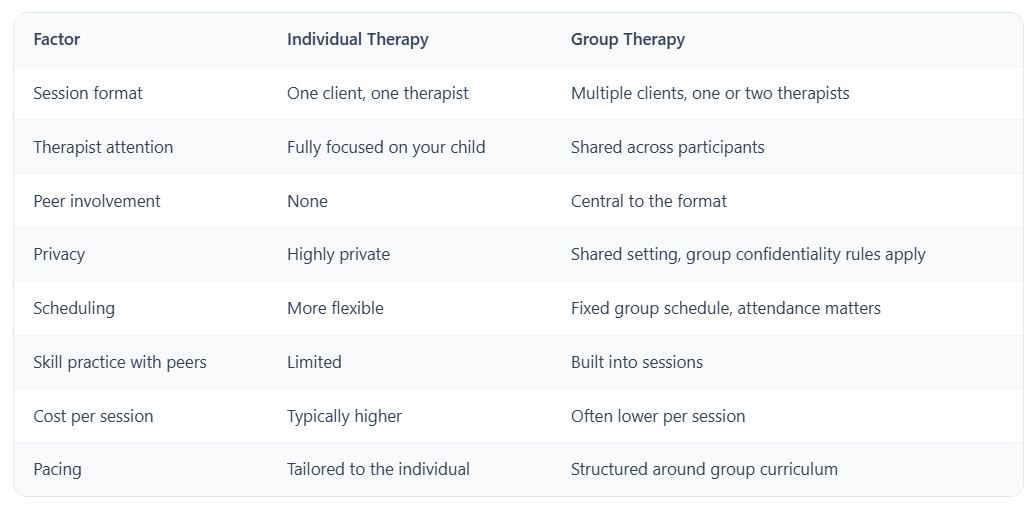
Individual sessions offer depth and direct attention. Group sessions offer connection, real-time skill practice, and the experience of knowing others share similar challenges. Neither is automatically better.
Therapy Approaches Work in Both Formats
One point worth clarifying: cognitive behavioral therapy (CBT), dialectical behavior therapy (DBT), and similar approaches are treatment models, not formats. CBT can be delivered in an individual session or in a structured group setting. The format describes who is in the room. The approach describes how the therapist works.
That distinction matters when you are evaluating options. Ask what therapeutic approach the group or individual work will use, not just whether it is group or individual.
Family therapy is also its own distinct format. It focuses on relationships and communication within a family unit and should not be treated as equivalent to group counseling with unrelated participants.
When One Format May Fit Better
There is no universal rule. But certain patterns can help you think through the decision.
Individual therapy often fits better when:
Your child is working through trauma or abuse
Sensitive personal details need a fully private setting
Your child needs a slower pace or more customized support
The presenting concerns are highly specific and not widely shared by peers
Group therapy often fits better when:
Your child wants to know other kids share similar experiences
Social skills, peer communication, or relationship patterns are part of the treatment goal
The presenting concern (anxiety, grief, ADHD-related social challenges) matches a well-designed group curriculum
Cost or scheduling makes individual sessions difficult to sustain
Do not assume shy children cannot benefit from groups. Shyness alone is not a reason to avoid a group. What matters more is whether the group is structured well, whether the therapist has experience with children of that age, and whether your child is emotionally ready to participate.
Questions to Ask Before Starting
Before committing to either format, these questions will help you evaluate the specific program or provider:
What treatment goals does this format address for children my child's age?
How does the therapist assess whether a child is ready for group participation?
How are group participants matched by age, concern, and readiness?
How are parents kept informed without compromising the child's privacy?
What happens if the format is not working?
What are the fees, cancellation policies, and attendance expectations?
On privacy: therapists in both formats explain confidentiality rules and their limits at the start. In a group setting, participants are expected to keep what is shared private, but a therapist cannot guarantee that every member will. Ask the therapist how sensitive topics are handled and what group rules are in place.
Combining Both Formats
Some children work with both formats at the same time. A child receiving individual therapy for anxiety may also join a social skills group to practice what they are learning in a real peer context. A therapist can coordinate between the two if the same practice provides both.
In practice, combining formats tends to work best when there is clear communication between providers and when the goals of each format are distinct rather than duplicated.
About The Mind Center for Kids
The Mind Center, LLC, also known as The Mind Center for Kids, provides individual and group therapy for children, teenagers, adults, and families across Washington, DC, Maryland, Virginia (including Northern Virginia), and South Florida, covering Palm Beach, Broward, and Miami-Dade counties. The practice also offers comprehensive services including psychoeducational evaluations, ADHD testing, autism assessments, and school support.
With approximately 15 years of experience and more than 5,000 school-based evaluations completed, The Mind Center brings both clinical depth and practical school knowledge to every family it works with. Virtual options are available for certain services, including virtual psychoeducational testing washington dc for families in the DC area.
Unsure whether group therapy vs individual therapy is the right starting point for your child? Reach out directly through the contact page or call (561) 888-0102 to schedule a consultation and discuss which format best fits your child's needs and goals.
Frequently Asked Questions
Q: Who should not do group therapy?
Group therapy is not the right fit for every child or situation.
Children who are actively in crisis, dealing with acute trauma, or working through highly sensitive personal details that require full privacy may need individual therapy first. A child who is not yet emotionally ready to engage with peers in a structured setting, or whose behavior may significantly disrupt the group dynamic, may need individual support before transitioning to a group format. The goal is not to exclude, but to match the child to the format where they are most likely to benefit.
Q: What is an individual therapy?
Individual therapy is a format in which one client works directly with a licensed therapist in a private setting.
Sessions are fully tailored to that person's specific concerns, goals, and pace. A therapist may use approaches such as cognitive behavioral therapy, play therapy, or talk therapy depending on the child's age and presenting needs. There is no fixed curriculum shared with other participants, which allows the therapist to adjust direction from session to session based on what the child needs most at that time.
Q: What are the downsides of group therapy?
Group therapy offers real benefits, but it comes with trade-offs that are worth understanding before you commit.
Therapist attention is shared across all participants, so your child will not receive the same focused, individualized focus that a one-on-one session provides. Scheduling is less flexible because the group meets on a fixed calendar, and attendance expectations are usually firm since one child's absence affects the whole group's progress. Privacy is also a genuine concern. While group members are expected to keep what is shared confidential, a therapist cannot guarantee that every participant will honor that. Sensitive personal topics may not be appropriate to raise in a group setting.
Q: Can you do group and individual therapy at the same time?
Yes, and for some children, combining both formats produces stronger outcomes than either one alone.
A child receiving individual therapy for anxiety, for example, may also participate in a structured social skills group to practice the coping strategies they are developing in their one-on-one sessions. The two formats address different dimensions of treatment and can reinforce each other when the goals are clearly defined. If both formats are provided by different therapists, coordination between those providers matters. Ask whether the therapists will communicate with each other and how progress will be tracked across both settings.
Q: Does insurance cover individual therapy?
Many insurance plans do cover individual therapy, but coverage varies widely depending on your plan, provider, and diagnosis.
Most major health insurance plans in the United States include some level of behavioral health benefits under the Mental Health Parity and Addiction Equity Act, which requires coverage for mental health services to be comparable to medical coverage. That said, your specific plan may require a referral, prior authorization, or a diagnosis code before approving sessions. Copays, deductibles, and session limits differ across plans. Contact your insurance provider directly and ask whether the therapist you are considering is in-network. Some practices also offer sliding scale fees or superbills for out-of-network reimbursement.
The Bottom Line on Group Therapy vs Individual Therapy
Choosing between therapy formats is not about picking the "right" or "wrong" option. It is about matching your child to the setting where they can make real progress. Individual sessions offer privacy, focused attention, and flexible pacing. Group sessions offer peer connection, structured skill practice, and the normalizing experience of realizing other kids face similar challenges.
Both formats are backed by clinical evidence. Both can be delivered using approaches like CBT. And both can work together when the goals are clear and the providers are communicating well. What matters most is asking good questions before you start, staying involved as the plan unfolds, and being willing to revisit the format if your child's needs shift.
If you are weighing group therapy vs individual therapy for your child and are not sure where to begin, The Mind Center for Kids can help you think through the options. Serving families in Washington, DC, Maryland, Virginia, and South Florida, the practice offers individual and group therapy alongside comprehensive evaluations and school support. Call or text (561) 888-0102 or visit the contact page to schedule a consultation.