What Parents Should Know About Autism Evaluation in Children
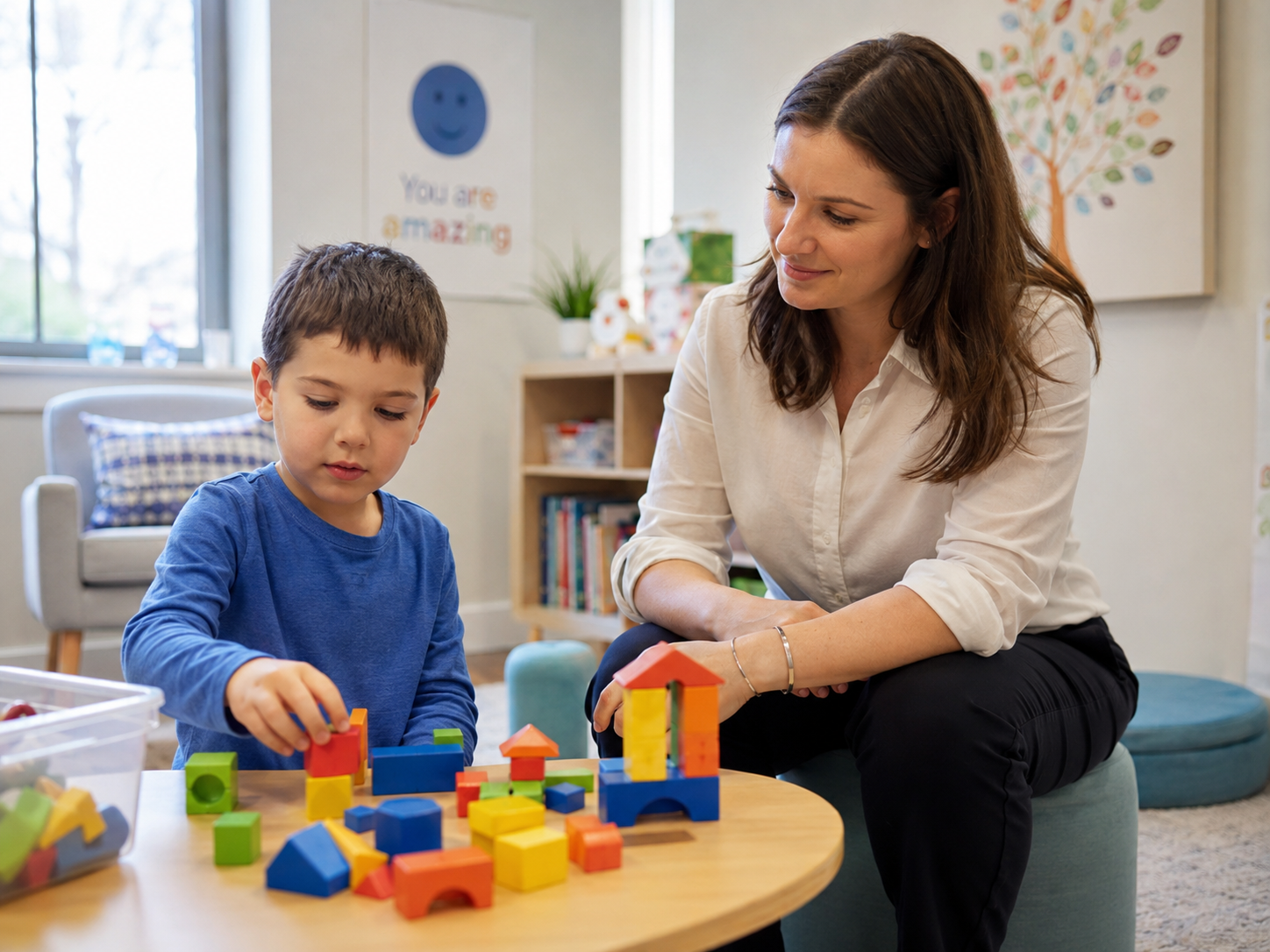
If you have noticed something different about the way your child communicates, plays, or connects with others, you are not alone, and you are right to pay attention. An autism evaluation in children is a structured, professional process designed to help families understand how their child thinks, learns, and experiences the world, so the right support can be put in place as early as possible.
Key Takeaways
Autism signs can be subtle and show up differently at home, school, or during social situations, making professional evaluation especially valuable.
The CDC estimates that about 1 in 31 children aged 8 years has been identified with autism spectrum disorder, a figure that reflects improved detection efforts.
A comprehensive evaluation typically includes behavioral observation, developmental history, parent interviews, speech assessments, and cognitive testing.
Early identification leads to better long-term outcomes. The American Academy of Pediatrics recommends screening at 18 and 24 months.
An evaluation is not about labeling your child. It is about understanding their strengths, challenges, and learning style so they can thrive.
Bright, verbal, or highly social children can still benefit from an autism evaluation if certain patterns of behavior raise questions.
Why More Families Are Seeking Answers
It was not long ago that autism was considered rare. Today, the CDC reports that approximately 1 in 31 children aged 8 years has been identified with autism spectrum disorder (ASD). That number has risen steadily since 2000, when the estimate was 1 in 150, and experts widely attribute this increase to better awareness, improved screening tools, and broader diagnostic criteria rather than a true rise in cases.
Despite growing awareness, the average age of diagnosis in the United States remains around 4 years old, even though the American Academy of Pediatricsrecommends autism screening at the 18- and 24-month well-child visits. That gap matters. Research consistently shows that earlier intervention leads to meaningfully better developmental outcomes. When families and clinicians catch early signs and act on them, children gain access to support during the years when their brains are most adaptable.
If you are a parent with a nagging feeling that something is off, that instinct deserves to be heard and explored with the right professionals.
What Autism Actually Looks Like in Children
One of the most important things to understand is that autism spectrum disorder does not have a single, fixed appearance. Two children with the same diagnosis can look and behave very differently from each other. Autism exists on a spectrum, which means the traits your child shows may be subtle, mixed with strengths, or only visible in specific situations.
Some children show noticeable signs early in toddlerhood. Others appear to develop typically and then parents begin to notice differences as social demands increase, usually around preschool or early elementary school. A few children, particularly girls and those with strong verbal skills, are often described as having learned to "mask," meaning they work hard to fit in socially, which can make their challenges less visible to others but more exhausting for them.
Social Communication Differences
The most commonly discussed signs of autism involve social communication. This does not always mean a child who avoids people or never speaks. It can look like:
Difficulty understanding sarcasm, jokes, or non-literal language
Challenges with back-and-forth conversation, such as staying on a topic the other person chooses
Limited use of eye contact, facial expressions, or gestures in expected ways
Trouble reading social cues, such as when someone is bored or uncomfortable
Preferring to talk about one specific interest at length without noticing the listener's response
Routines, Sensory Experiences, and Intense Interests
Beyond social communication, many children with autism show a strong reliance on predictable routines. A change in the morning schedule, a substitute teacher, or an unexpected plan shift can trigger significant distress. This is not defiance or manipulation. It reflects how certain brains process uncertainty.
Sensory sensitivities are also worth noting. Some children are overwhelmed by loud environments, scratchy fabrics, bright lights, or unexpected touch. Others actively seek intense sensory input, such as spinning, crashing into furniture, or touching every surface. The STAR Institute for Sensory Processing describes these responses as reflecting how the nervous system processes and regulates sensory information, a factor central to many autism evaluations.
Intense interests, sometimes called "special interests," are another common feature. These go beyond typical childhood obsessions. A child might develop encyclopedic knowledge of a specific topic and struggle to engage with anything outside of it.
How Autism Can Show Up Differently at Home and School
One pattern that surprises many parents is that their child may behave very differently at home than at school, or vice versa, and this is more common than many families realize when they explore the available services.
At home, some children feel safe enough to let out the frustration or anxiety they have been holding in all day. A child who holds it together at school may melt down the moment they walk through the front door. Teachers might describe the child as cooperative and quiet, while parents are managing significant emotional dysregulation every evening.
The reverse also happens. A child may thrive with the familiar routines and predictable one-on-one environment at home, but struggle significantly in a noisy, socially complex classroom. Transitions between activities, unstructured time like recess, and group projects can expose challenges that do not appear in quieter settings.
This discrepancy between settings is itself clinically meaningful. A thorough autism evaluation collects observations and input from multiple environments, because no single setting tells the full story.
What Happens During an Autism Evaluation for a Child
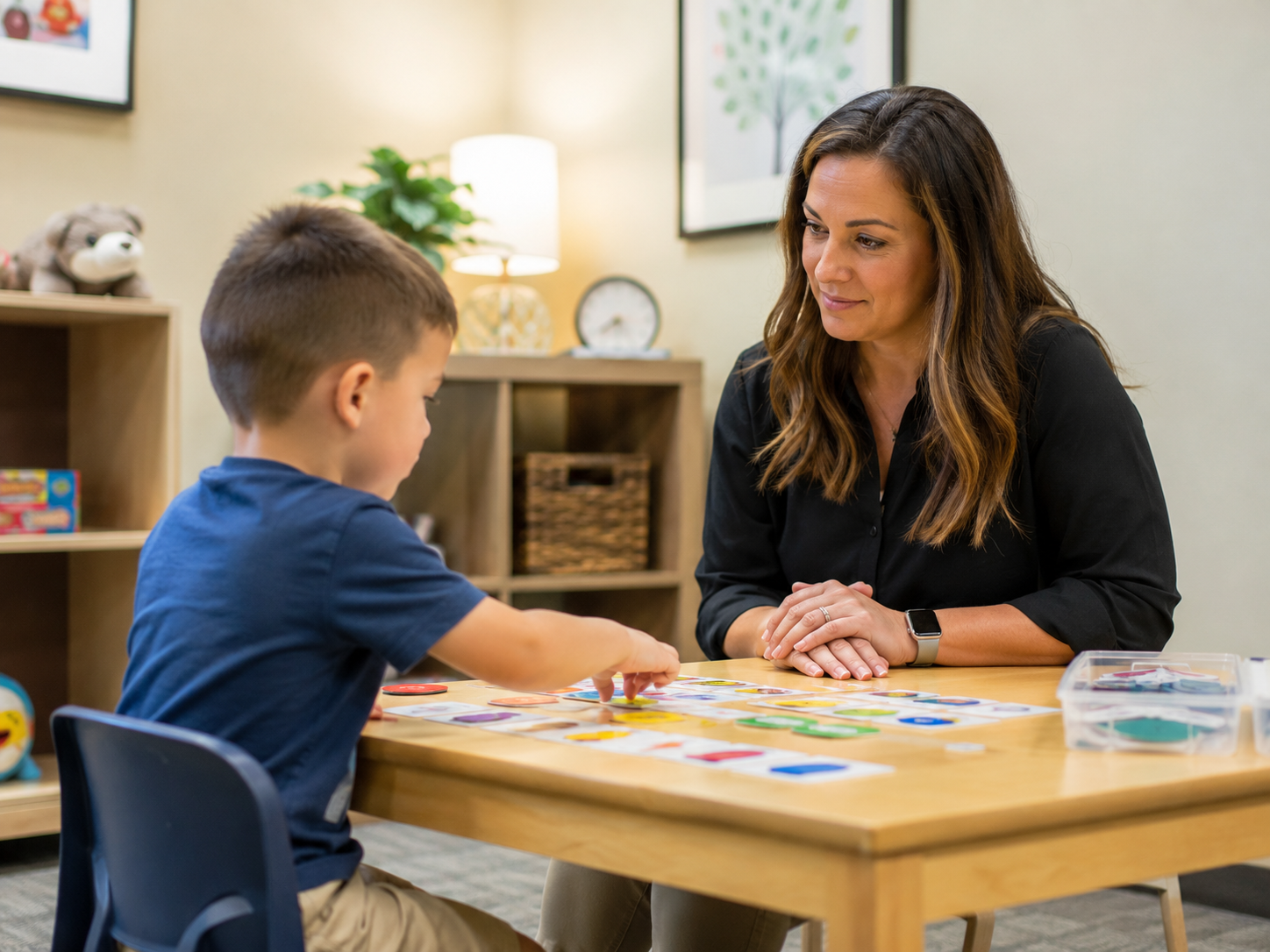
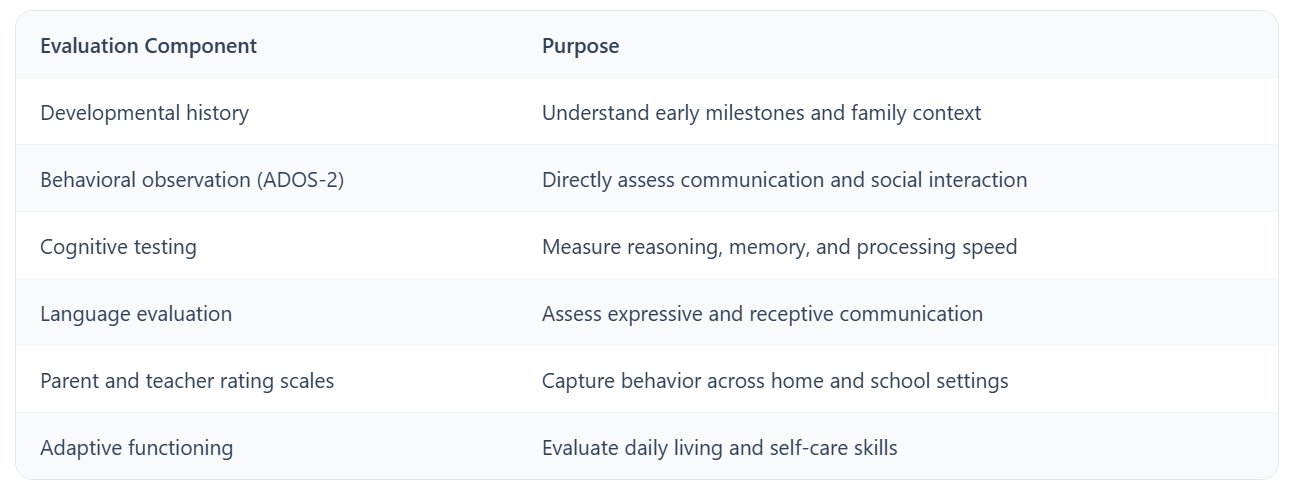
A comprehensive autism evaluation in children is not a single quick appointment. The process typically spans several hours across one or more sessions and involves a multi-step approach. Most evaluations include:
Developmental history interview: A clinician speaks in depth with parents about the child's early development, milestones, behaviors, and family history.
Behavioral observation: The evaluator spends direct time with the child in structured and semi-structured activities.
Standardized assessments: Tools like the Autism Diagnostic Observation Schedule, Second Edition (ADOS-2), which is widely considered the gold standard for autism assessment, are used to evaluate communication, social interaction, and play.
Cognitive and language testing: Evaluators assess how the child processes information, learns, and uses language.
School and parent rating scales: Caregivers and teachers complete questionnaires that capture behavior across settings.
Sensory and adaptive functioning measures: These assess daily living skills and how the child responds to their environment.
The result is not just a diagnosis. It is a detailed picture of the child's profile, including their strengths, learning style, challenges, and specific recommendations for school, therapy, and home support. The comprehensive approach to understanding each child's needs is what makes virtual psychoeducational testing a valuable tool alongside in-person evaluation options.
Subtle Signs Parents Often Overlook
Some of the most meaningful signals are easy to miss, especially when a child is otherwise doing well academically or socially. A few patterns worth considering include:
Emotional regulation difficulties: Intense reactions to small frustrations, difficulty calming down, or unexpected emotional swings that seem disproportionate.
Peer relationship struggles: Your child may want friends but consistently have trouble making or keeping them, despite effort.
Preference for adult company: Some children find adult conversation more predictable than peer interaction.
Literal thinking: Taking idioms, jokes, or instructions very literally and becoming confused or distressed when meaning is unclear.
Fatigue after social situations: Children who are exhausted after school, parties, or group settings may be expending significant energy to manage social demands.
Unusual responses to pain or illness: Some children with autism have very high or very low pain thresholds.
If any of these patterns resonate, exploring the topic further through resources on The Mind Center's blogcan help you gather more context before reaching out to a professional.
Why Verbal or High-Achieving Children Are Often Missed
A common misconception is that autism only applies to children who are non-verbal, significantly delayed, or obviously struggling. In reality, many children who are bright, articulate, and successful academically still meet criteria for autism. Their intelligence may allow them to compensate for social communication differences for years, but compensation has a cost.
The Autism Society of America notes that girls in particular are frequently underdiagnosed because they often present differently than the profiles clinicians have traditionally been trained to identify. Strong verbal skills, a desire to connect socially, and effective masking can all delay identification, sometimes well into adolescence or adulthood.
For families who want to explore virtual options, the specialized clinicians offering assessment tools provide valuable starting points, particularly for older children or those in areas without local access to specialists using approaches like virtualpsycho-educationaltesting.
Things to Know
Autism is more than 3 times more commonly diagnosed in boys than in girls, but girls are frequently underdiagnosed due to different presentation patterns and masking behaviors.
A diagnosis of autism does not limit your child. It opens doors to targeted support, school accommodations, and therapies designed for their specific profile.
Not every child who shows some autism traits will meet full diagnostic criteria. An evaluation provides clarity either way.
The ADOS-2 is the most widely used standardized tool, but a thorough evaluation always incorporates multiple data sources, not just one test.
Waitlists for autism evaluations can be long in many parts of the country. It is worth getting on a waitlist early even if you are still uncertain.
Your observations as a parent are valuable clinical data. No one knows your child better than you do.
Ready to Seek Clarity for Your Child?
If anything in this article has reflected your experience, the most helpful next step is simply to start a conversation with a qualified professional. You do not need to have all the answers before reaching out. An evaluation is designed to help you find them.
The Mind Center offers comprehensive evaluations for children and teens, with thoughtful, individualized recommendations that translate directly into school support plans, therapy referrals, and practical strategies for home. To learn more or schedule a consultation, please contact The Mind Center today. Getting clarity is not about labeling your child. It is about giving them the tools they deserve.
Frequently Asked Questions
Q: What are signs my child may need an autism evaluation?
Key signs include difficulty with social communication, strong attachment to routines, sensory sensitivities, trouble with peer relationships, and emotional regulation challenges.
These signs do not all need to be present, and they can vary widely between children. If you have noticed a consistent pattern that affects your child's daily life at home, school, or in social situations, it is worth speaking with a professional about whether an evaluation is appropriate.
Q: Can autism signs look different at home and school?
Yes, it is very common for autism-related behaviors to appear differently across settings, and this contrast is itself clinically important information.
Some children hold themselves together at school through significant effort and then experience emotional dysregulation at home. Others struggle more in the noisy, unpredictable school environment while thriving in familiar home routines. A thorough evaluation always gathers input from both settings.
Q: What happens during an autism evaluation for a child?
A comprehensive autism evaluation typically involves a developmental history interview, direct behavioral observation using tools like the ADOS-2, cognitive and language testing, and parent and teacher questionnaires.
The process usually takes 2 to 4 hours and may be spread across more than one appointment. At the end, families receive a detailed report with a diagnostic conclusion and specific, actionable recommendations for school and home support.
Q: Can a child be bright or verbal and still need an autism evaluation?
Absolutely, and in fact, children with strong verbal skills or high academic performance are among those most frequently missed.
Intelligence can mask social communication differences for years. Many children learn to compensate through observation and imitation, but this takes a significant toll on their energy and wellbeing. An evaluation looks at the full picture, not just academic performance.
Q: When should parents seek autism testing for their child?
If you are noticing consistent patterns around social communication, sensory responses, emotional regulation, or rigid routines that are affecting your child's daily life, it is a reasonable time to seek an evaluation.
The NIH recommends early screening and assessment whenever developmental concerns arise. Earlier identification allows earlier access to intervention, which research consistently links to better long-term outcomes for children.
The Bottom Line on Autism Evaluation in Children
Seeking an autism evaluation in children is not a dramatic step or an admission that something is terribly wrong. It is a thoughtful, proactive decision that gives your child access to the understanding and support they deserve. Whether the evaluation confirms autism or points toward a different explanation, you come out on the other side with clarity, which is always more useful than uncertainty.
If you have been wondering whether your child's experiences warrant a closer look, trust that instinct. Reach out to a qualified evaluation center, ask your pediatrician for a referral, or start by gathering more information so you can walk into that first conversation prepared and confident.
About The Mind Center
At The Mind Center LLC, we specialize in comprehensive psycho-educational evaluations for children, teens, and college students. Our experienced clinicians help families identify learning differences such as ADHD, learning disabilities such as dyslexia, dysgraphia, dyscalculia, as well as autism spectrum disorders and giftedness, while also providing documentation for IEP plans, 504 accommodations, and standardized testing accommodations such as the SAT, LSAT, MCAT and ACT.
With 15+ years of experience and over 1,000 evaluations completed, our team works closely with families and schools to uncover each child’s unique learning profile and provide clear recommendations that help students succeed academically and emotionally.
Areas We Serve
The Mind Center works with families seeking psychoeducational evaluations and ADHD testing across the Washington DC metropolitan area and South Florida. Many parents reach out when their child is struggling in school and they want clear answers about learning differences, attention challenges, or academic accommodations.
Washington DC, Maryland, and Virginia
Washington, DC
Montgomery County, Maryland
Bethesda • Rockville • Potomac • Silver Spring
Prince George’s County, Maryland
Bowie • Upper Marlboro • Greenbelt • Laurel
Arlington County, Virginia
Arlington
Fairfax County, Virginia
McLean • Fairfax • Alexandria
South Florida
Broward County
Fort Lauderdale • Hollywood • Pembroke Pines
Palm Beach County
Boca Raton • West Palm Beach • Palm Beach Gardens
Miami-Dade County
Miami • Coral Gables • Aventura
Services We Provide
Our evaluation services include:
ADHD Testing
Dyslexia Evaluations
Gifted & Talent Assessments
Comprehensive Psychoeducational Evaluations
College Accommodation Evaluations
Independent Educational Evaluations (IEE)
Private School Admission Testing
Learning Disability Assessments
Neuropsychological Evaluations