Autism Screening vs. a Full Evaluation: What Parents Really Need to Know

Autism screening is a process used to identify children who may show early signs of autism spectrum disorder, helping families decide whether a more comprehensive evaluation is needed. Screening tools are a useful starting point, but they are not the same as a diagnosis, and they work best when followed up with a thorough, professional assessment.
Key Takeaways
Autism screening tools can flag early concerns but cannot confirm or rule out an autism diagnosis on their own.
Many autism-related signs overlap with ADHD, anxiety, giftedness, and learning challenges, making comprehensive evaluation essential.
A full psychoeducational or autism evaluation goes far beyond a checklist and examines cognitive, social, emotional, and developmental functioning.
School screenings are limited in scope and often do not capture the full picture of a child's needs.
Early, accurate evaluation can unlock school supports, IEP and 504 documentation, therapy recommendations, and practical accommodations.
If you have persistent concerns about your child's development, reaching out to a qualified specialist is a meaningful next step.
Why Screening Is Only the Beginning
If you have been Googling your child's behaviors late at night, filling out online questionnaires, or getting vague reassurances from teachers, you already know how confusing this process can feel. Autism screening tools, whether they are brief checklists your pediatrician uses or online assessments you find yourself at , are designed to flag children who may benefit from further evaluation. They are not designed to give you answers.
Common tools like the M-CHAT-R (Modified Checklist for Autism in Toddlers) are used by pediatricians during well-child visits. Schools may also conduct informal observations or developmental screenings. These tools ask about things like eye contact, response to name, pointing behaviors, and social play. They are fast, which makes them efficient for large populations. But fast also means limited.
What a screener cannot do is tell you why your child does what they do, how their brain processes information, what their cognitive strengths are, or what specific supports they actually need. For that, you need something more.
Signs That May Prompt an Autism Screening
Parents often come to screening because something just feels off, even when they cannot name it precisely. Some of the most common concerns include:
Social communication differences: Your child does not respond to their name, rarely makes eye contact, or does not engage in back-and-forth conversation the way other children do.
Repetitive behaviors or intense interests: They line up toys, insist on rigid routines, or become deeply fixated on one or two topics to an unusual degree.
Sensory sensitivities: Certain textures, sounds, or lights cause significant distress or avoidance.
Difficulty with transitions: Moving from one activity to the next, even simple ones, leads to emotional meltdowns that seem out of proportion.
Speech or language delays: Words are coming late, or your child uses language in unusual ways.
School struggles: Teachers are flagging attention issues, emotional dysregulation, difficulty following group directions, or trouble making friends.
Here is where things get complicated. All of these signs can also point to other things entirely. ADHD, anxiety, giftedness, speech-language disorders, sensory processing differences, and learning disabilities can look remarkably similar to autism, and in many cases, they co-occur. A screening tool is not equipped to sort that out. A comprehensive evaluation is.
What a Comprehensive Evaluation Actually Covers
This is the part most parents do not fully understand until they are sitting in an evaluation office. A thorough psychoeducational or autism testing evaluation isa structured, multi-hour process conducted by a trained psychologist or evaluation team. It typically includes:
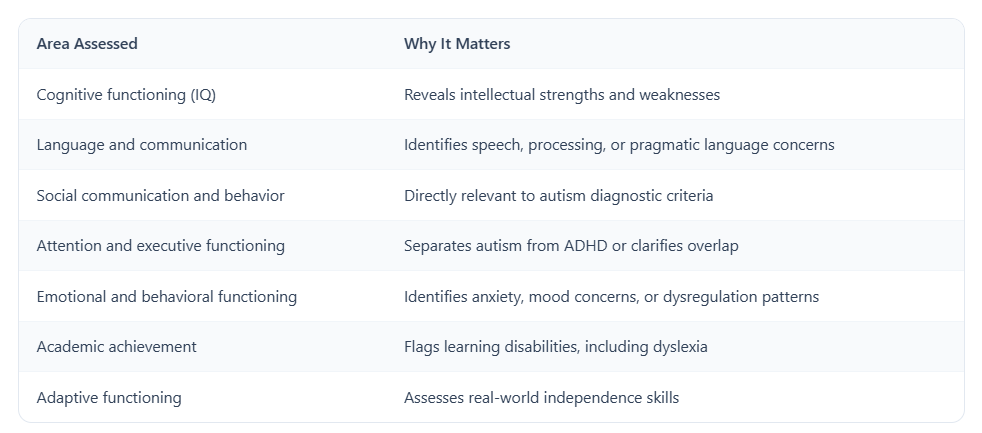
The goal of all of this is not just a label. It is a clear, practical picture of who your child is, how they learn, what gets in the way, and what can genuinely help them.

How Autism Overlaps With Other Diagnoses
One of the most important things to understand is that autism does not always look the same, and it rarely travels alone. Many children who come in for autism screening are eventually found to have ADHD, a learning disability, or significant anxiety alongside autism, or instead of it.
For example, a child who has trouble making eye contact, struggles with group work, and seems overwhelmed by the classroom environment might have autism. They might also have adhd testing needs that go unmet because attention issues are being interpreted through the wrong lens. Similarly, a child who appears to be academically behind may actually be gifted with an undiagnosed learning challenge, a combination sometimes called "twice exceptional."
If you are also concerned about reading, writing, or math struggles, learning disability testing can be part of a broader evaluation.Getting to the right answers matters enormously for school planning. IEP and 504 documentation, therapy referrals, and classroom accommodations all depend on having accurate, complete information about what is actually going on.
The Mind Center for Kids: Evaluations Built for Real Families
The Mind Center for Kids works with families across Washington, DC, Maryland, Virginia, and Florida, including South Florida, to provide comprehensive psychoeducational and autism testing evaluations for children, teens, and young adults. Their process is built to give families something they often do not get from screenings alone: real answers.
Evaluations at The Mind Center are designed to be thorough without being overwhelming. The team understands that parents come in carrying a lot, including confusion, worry, and sometimes exhaustion from years of "wait and see." The reports they produce are written to be readable and practical, not stacked with clinical jargon you have to decode on your own.
Alongside autism evaluations, The Mind Center also offers ADHD evaluations, dyslexia testing, executive functioning assessment, gifted testing, and school consultation. Whether your child needs one piece of the puzzle or the whole picture, evaluations can be customized to fit the questions you are actually asking.
Things to Know
Online autism screeners and questionnaires are a reasonable first step, but a positive result does not mean your child has autism, and a negative result does not mean they do not.
Many schools conduct developmental screenings, but these are not the same as clinical evaluations and typically do not result in actionable documentation for IEPs or 504 plans.
Insurance coverage for autism evaluations varies widely. It is worth calling your provider to ask specifically about neuropsychological or psychoeducational testing benefits.
Age matters less than you might think. While early screening is often emphasized, children, teens, and even young adults can benefit significantly from a first-time comprehensive evaluation.
Co-occurring conditions like anxiety or ADHD are extremely common in children with autism, which is exactly why a thorough evaluation covers more than just autism criteria.
Ready to Take the Next Step for Your Child?
If you have been wondering whether your child's behaviors, struggles, or development call for a closer look, the clearest next step is a conversation with a specialist who can help you figure out what kind of evaluation makes sense. You can find answers to common questions on the faqspage, or go directly to the contactpage to reach out and discuss your specific concerns. You do not need to have everything figured out before you call.
The Bottom Line on Autism Screening
Autism screening is a valuable tool for catching early concerns, but it is the beginning of a process, not the end of one. If a screener has flagged concerns, or if you have noticed signs that just do not add up, a comprehensive evaluation is the most reliable way to get clarity.
Understanding your child's full profile, including their strengths, challenges, and the way they experience the world, gives you and their school the foundation to actually help them. That is what a thorough evaluation is designed to provide, and it is exactly what families across DC, Maryland, Virginia, and Florida have found through The Mind Center for Kids.
About The Mind Center
At The Mind Center LLC, we specialize in comprehensive psycho-educational evaluations for children, teens, and college students. Our experienced clinicians help families identify learning differences such as ADHD, learning disabilities such as dyslexia, dysgraphia, dyscalculia, as well as autism spectrum disorders and giftedness, while also providing documentation for IEP plans, 504 accommodations, and standardized testing accommodations such as the SAT, LSAT, MCAT and ACT.
With 15+ years of experience and over 1,000 evaluations completed, our team works closely with families and schools to uncover each child’s unique learning profile and provide clear recommendations that help students succeed academically and emotionally.
Areas We Serve
The Mind Center works with families seeking psychoeducational evaluations and ADHD testing across the Washington DC metropolitan area and South Florida. Many parents reach out when their child is struggling in school and they want clear answers about learning differences, attention challenges, or academic accommodations.
Washington DC, Maryland, and Virginia
Washington, DC
Montgomery County, Maryland
Bethesda • Rockville • Potomac • Silver Spring
Prince George’s County, Maryland
Bowie • Upper Marlboro • Greenbelt • Laurel
Arlington County, Virginia
Arlington
Fairfax County, Virginia
McLean • Fairfax • Alexandria
South Florida
Broward County
Fort Lauderdale • Hollywood • Pembroke Pines
Palm Beach County
Boca Raton • West Palm Beach • Palm Beach Gardens
Miami-Dade County
Miami • Coral Gables • Aventura
Services We Provide
Our evaluation services include:
ADHD Testing
Dyslexia Evaluations
Gifted & Talent Assessments
Comprehensive Psychoeducational Evaluations
College Accommodation Evaluations
Independent Educational Evaluations (IEE)
Private School Admission Testing
Learning Disability Assessments
Neuropsychological Evaluations