Signs Your Bright Child May Be Twice-Exceptional (2e)

Your child reads three grade levels ahead.
They ask complex questions about the universe.
They use words most adults don’t.
And yet…
They forget homework.
They melt down over small mistakes.
They struggle with writing.
They avoid reading aloud.
They say, “I’m stupid,” even though you know they’re not.
If this feels familiar, you may be raising a twice-exceptional child.
Parents searching for twice exceptional signs are not confused about intelligence.
They are confused about the contradiction.
How can a child be gifted and struggling at the same time?
Let’s break it down.
WHAT DOES TWICE-EXCEPTIONAL MEAN?
A twice-exceptional child is both:
• Gifted, with advanced reasoning, creativity, or high verbal ability
AND
• Living with a learning, attention, or processing difference
Common combinations include:
Gifted and ADHD
Gifted and Dyslexia
Gifted and Dysgraphia
Gifted and Autism
Gifted and Executive Function weaknesses
Gifted and Anxiety
The result is a masking effect.
Strengths hide weaknesses.
Weaknesses hide strengths.
And the child often feels misunderstood.
THE CORE PATTERN: ADVANCED THINKING, UNEVEN OUTPUT
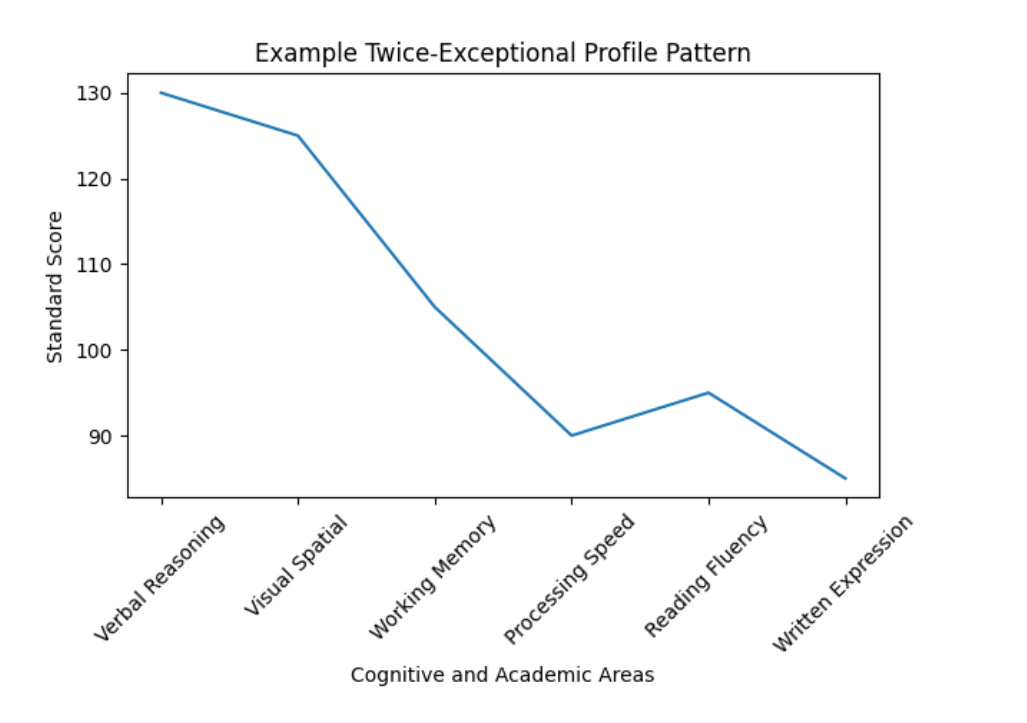
Most 2e children show asynchronous development.
Their thinking is far ahead of their academic production or emotional regulation.
Notice the scatter.
High peaks in reasoning.
Lower valleys in processing speed, reading fluency, or written expression.
That variability is not random.
It tells a story.
Averages hide this pattern.
Profile analysis reveals it.
THE STRENGTH VERSUS OUTPUT GAP
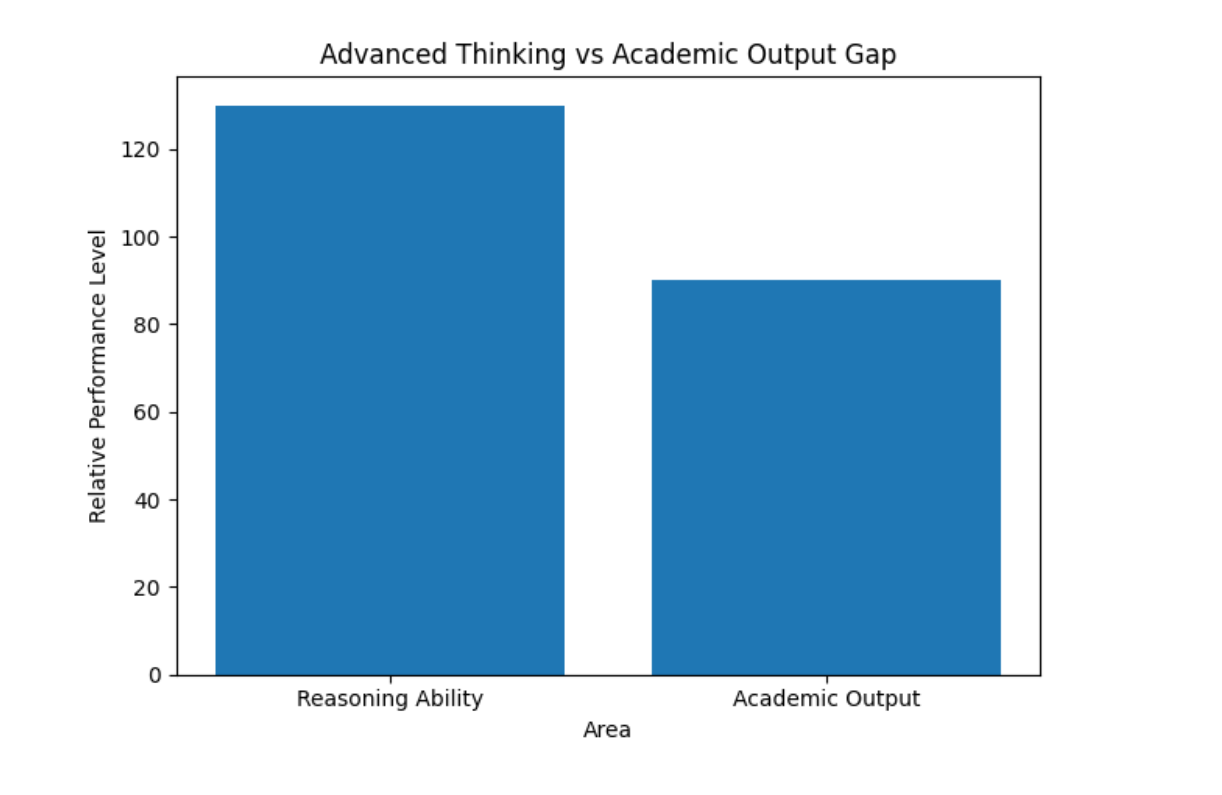
Another way to understand twice-exceptionality is this.
The child’s reasoning ability may be significantly higher than their academic output.
This gap explains why teachers may say:
“Brilliant but unmotivated.”
The child is not unmotivated.
They are overwhelmed by the mismatch between how fast they think and how slowly their output forms.
COMMON SIGNS OF A TWICE-EXCEPTIONAL CHILD
Use this as a starting checklist.
Cognitive Strengths
Learns complex ideas quickly
Advanced vocabulary
Creative problem solving
Intense curiosity
Strong moral reasoning
Academic Red Flags
Avoids writing tasks
Reads advanced books silently but struggles reading aloud
Excellent ideas but incomplete assignments
Large gap between verbal skills and written work
Inconsistent grades
Executive Function Indicators
Frequently forgets materials
Difficulty starting tasks
Loses track of time
Emotional shutdown during challenging work
Emotional Signs
Perfectionism that leads to paralysis
Anxiety around performance
Saying “I’m dumb” despite high ability
Overreacting to minor corrections
If you searched “gifted but struggling child,” this uneven pattern is the hallmark.
It is not laziness.
It is neurological complexity.
WHY 2E PROFILES ARE OFTEN MISSED
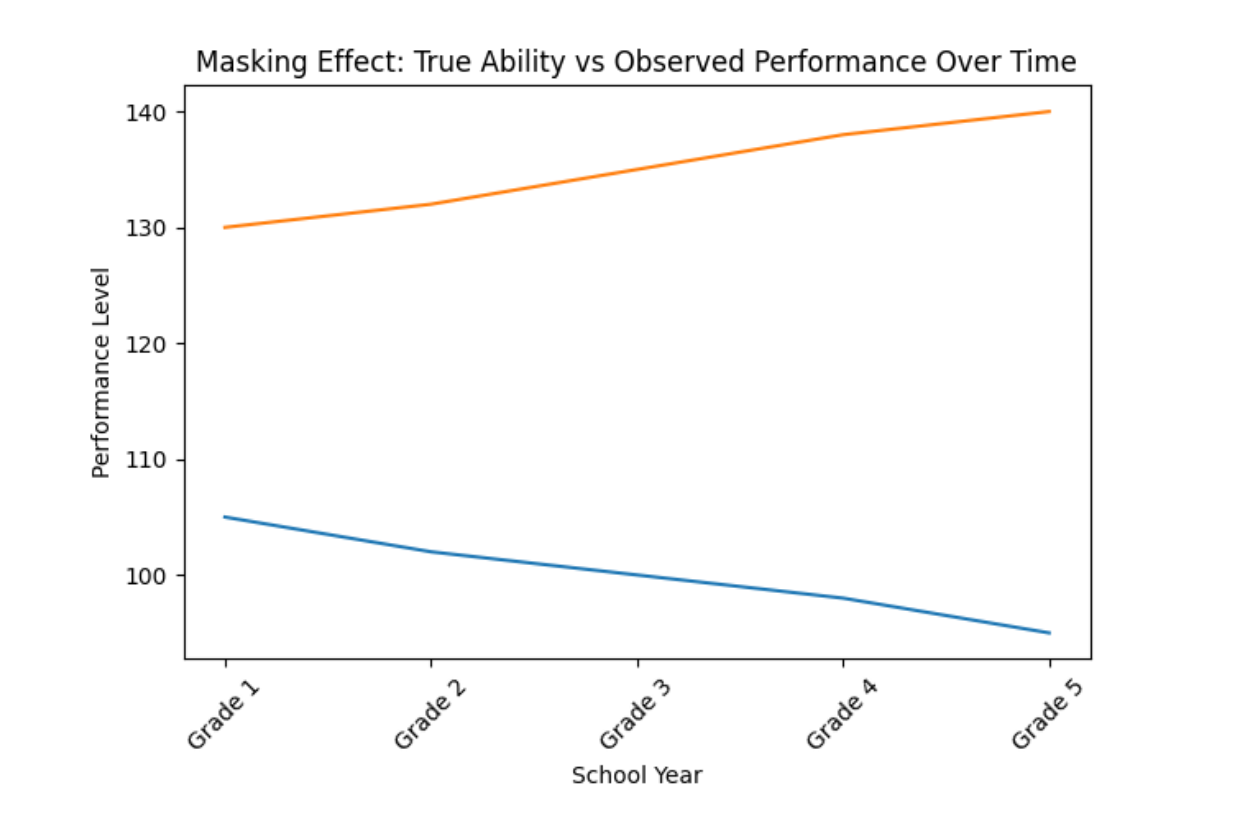
Twice-exceptional children are frequently overlooked because:
Giftedness compensates for weaknesses
Weaknesses suppress visible gifted performance
Schools may see average grades and stop investigating
When performance falls in the middle, no one asks why the extremes exist.
THE EMOTIONAL COST OF MISSING 2E
These children know they are smart.
They also know some things feel harder for them than for peers.
That internal contradiction can lead to:
Imposter feelings
Anxiety
School avoidance
Perfectionism
Behavioral outbursts
Twice-exceptionality is not just academic.
It is emotional.
HOW PSYCHOEDUCATIONAL TESTING CLARIFIES 2E PROFILES
When parents suspect twice exceptional signs, testing should include:
Full cognitive assessment
Academic achievement testing
Executive functioning measures
Attention testing
Emotional screening
Parent and teacher rating scales
A comprehensive evaluation looks for patterns, not just averages.
It asks:
Where are the peaks?
Where are the valleys?
How large is the gap?
That is how 2e is identified accurately.
WHAT HAPPENS IF 2E IS MISSED?
Without identification:
Gifted programs may be denied due to weak writing output
ADHD may be dismissed because grades look fine
Learning disabilities may go unnoticed due to IQ compensation
Anxiety increases
Self-esteem declines
Over time, the child may disengage completely.
Early identification protects both opportunity and confidence.
TWICE-EXCEPTIONAL IS NOT A CONTRADICTION
Your child can be:
Brilliant
Creative
Insightful
And still need support.
Support does not diminish giftedness.
It protects it.
About The Mind Center
At The Mind Center LLC, we specialize in comprehensive psycho-educational evaluations for children, teens, and college students. Our experienced clinicians help families identify learning differences such as ADHD, learning disabilities such as dyslexia, dysgraphia, dyscalculia, as well as autism spectrum disorders and giftedness, while also providing documentation for IEP plans, 504 accommodations, and standardized testing accommodations such as the SAT, LSAT, MCAT and ACT.
With 15+ years of experience and over 1,000 evaluations completed, our team works closely with families and schools to uncover each child’s unique learning profile and provide clear recommendations that help students succeed academically and emotionally.
Areas We Serve
The Mind Center works with families seeking psychoeducational evaluations and ADHD testing across the Washington DC metropolitan area and South Florida. Many parents reach out when their child is struggling in school and they want clear answers about learning differences, attention challenges, or academic accommodations.
Washington DC, Maryland, and Virginia
Washington, DC
Montgomery County, Maryland
Bethesda • Rockville • Potomac • Silver Spring
Prince George’s County, Maryland
Bowie • Upper Marlboro • Greenbelt • Laurel
Arlington County, Virginia
Arlington
Fairfax County, Virginia
McLean • Fairfax • Alexandria
South Florida
Broward County
Fort Lauderdale • Hollywood • Pembroke Pines
Palm Beach County
Boca Raton • West Palm Beach • Palm Beach Gardens
Miami-Dade County
Miami • Coral Gables • Aventura
Services We Provide
Our evaluation services include:
ADHD Testing
Dyslexia Evaluations
Gifted & Talent Assessments
Comprehensive Psychoeducational Evaluations
College Accommodation Evaluations
Independent Educational Evaluations (IEE)
Private School Admission Testing
Learning Disability Assessments
Neuropsychological Evaluations